
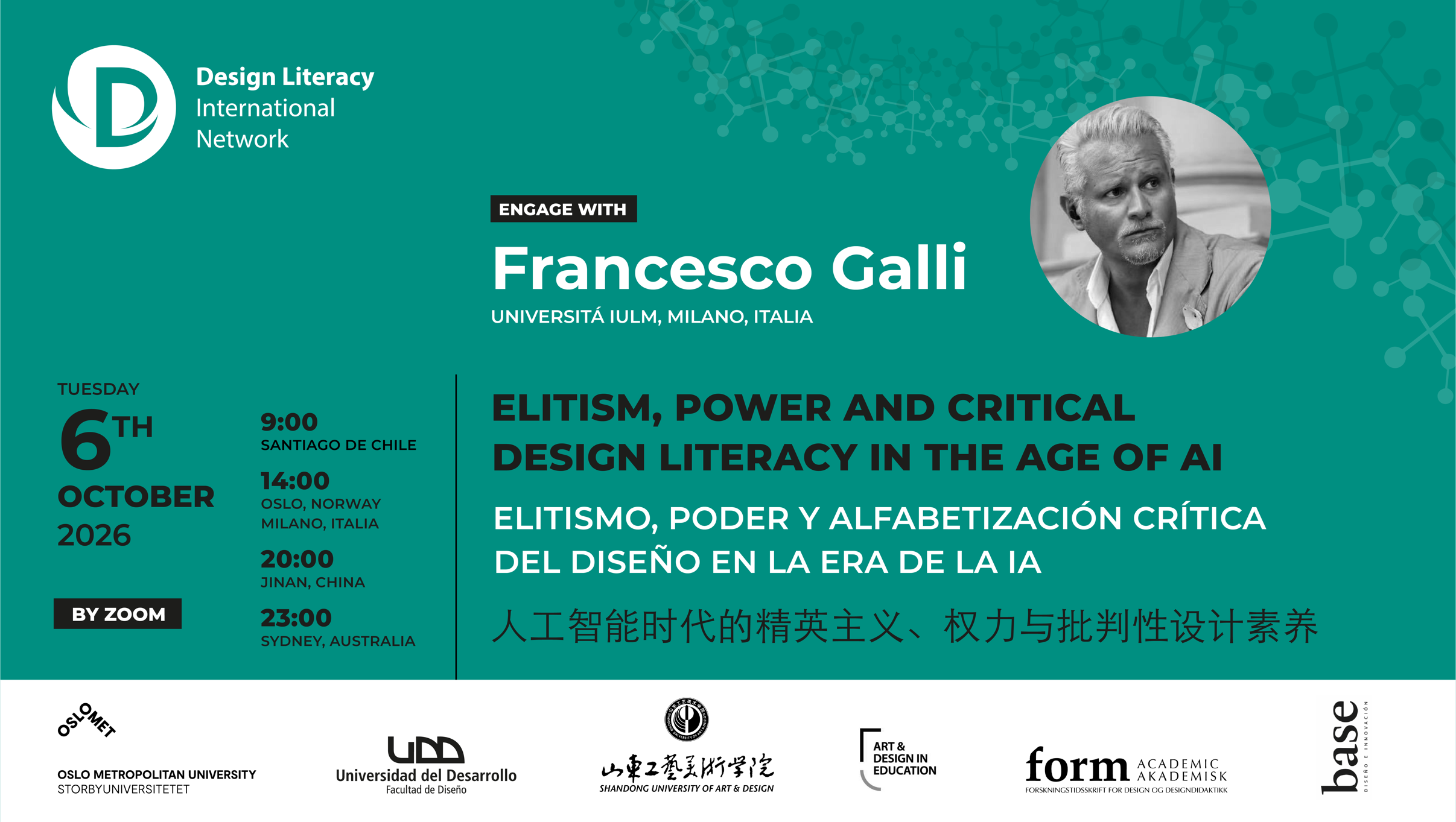
In the upcoming October’s Engaging with Ideas talk series, Francesco Galli will aim to address this question: How should Creative education respond to a world increasingly shaped by artificial intelligence, automated cultural production, and the politics of attention? through exploration of how design education can move beyond traditional paradigms of problem-solving toward more critical and reflective forms of leadership.
Francesco will draw on philosophy, political theory, and design studies, to examine how power operates through attraction, narratives, legitimacy, and symbolic infrastructures rather than only through coercion. Using the Sator Square as a speculative interpretive device, the research investigates how myths, ambiguity, and AI-mediated systems influence contemporary cultures of design and creativity
Central to the discussion is the concept of eligere—understood not as elitism in the conventional sense, but as the responsible capacity to select which questions, conversations, narratives, and infrastructures deserve attention and continuation under conditions of epistemic saturation. In this context, artificial intelligence is approached not as a neutral tool, but as a socio-technical apparatus that shapes knowledge, meaning, and cultural legitimacy.
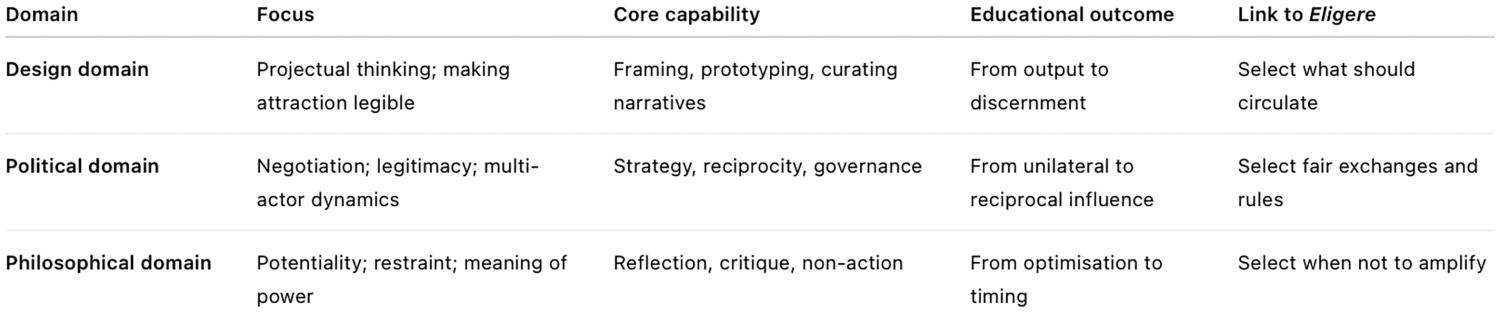
Francesco proposes that future design education should cultivate critical discernment, awareness of power dynamics, ethical reflection, and the capacity to recognise manipulation within AI-mediated environments. Rather than simply producing more content, Creative leaders and educators must learn how to critically govern meaning, attention, and participation in increasingly complex Geo-Techno-Political societies.

Francesco Galli is Professor in Leadership and Creative Thinking at IULM University in Milan, Italy. His research explores the intersections between design, leadership, power, philosophy, and creative education, with a particular focus on artificial intelligence and speculative approaches to design thinking. His recent work examines how emerging technologies reshape creative leadership, critical thinking, and educational paradigms under contemporary conditions of automated cultural production. Galli’s research combines perspectives from design studies, political theory, and philosophy to investigate how power operates through narratives, attraction, and symbolic infrastructures. He has published internationally on design thinking, negative knowledge, creative leadership, and AI-mediated educational practices.
References
Galli, F. (2026). Elitism in Design Education: Leadership Through Power, Myth and Kairotic Conversations with Artificial Intelligence, The Design Journal, DOI:10.1080/14606925.2026.2672409
Bookings
Bookings are closed for this event.