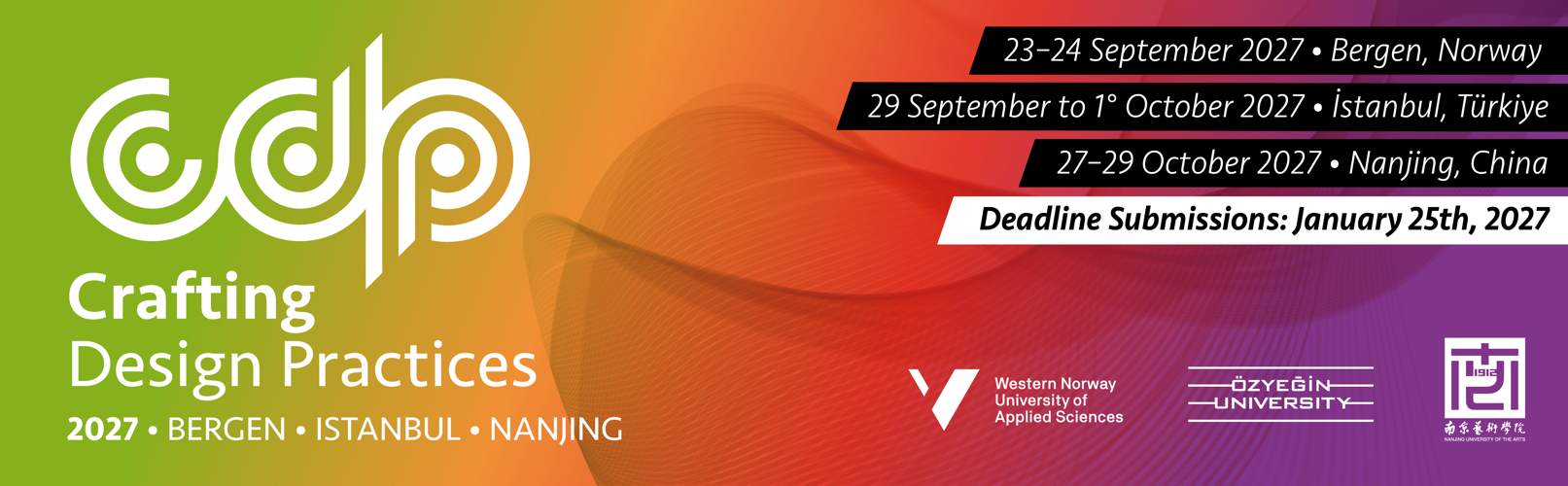
The 2027 Crafting Design Practices deadline for submission is due on Monday 15 February 2027. The list of key dates is below.
Fourteen Tracks form the 2027 Crafting Design Practices Call for Submissions. The table below summarises the types of submissions and locations (İstanbul | Türkiye or Nanjing | China) for each of the 14 tracks.
| Track | Research Papers | Case Studies | Workshops | Visual Papers | İstanbul Türkiye | Nanjing China |
|---|---|---|---|---|---|---|
| Track 01 Making It Up as We Scaffold Along | RP | CS | W | CN | ||
| Track 02 Design Literacy in Challenging Times | RP | CN | ||||
| Track 03 Design Literacy in K-12 Education | RP | CS | W | TR | ||
| Track 04 Literate by Design | RP | CS | W | VP | TR | |
| Track 05 Cultivating Ecological Design Literacy | RP | CS | VP | TR | ||
| Track 06 Designing Interfaces | RP | CS | W | VP | TR | |
| Track 07 Crafting Design Literacy Through Post-Disciplinary Practices of Design Computation | RP | CS | W | VP | TR | |
| Track 08 Design Literacy in Business | RP | CS | W | TR | ||
| Track 09 Across Boundaries | RP | CS | W | VP | CN | |
| Track 10 Discourse and Action in Architectural Design Education | RP | CS | VP | CN | ||
| Track 11 Biodesign Education | RP | CS | W | TR | CN | |
| Track 12 Crafting Visual Literacy Across Cultures | RP | CS | W | VP | CN | |
| Track 13 Crafting the Futures of Service Design | RP | CS | CN | |||
| Track 14 Design Limits and Gaps | RP | CS | W | VP | CN |
Tracks Call for Submissions
Outlines for each of the tracks can be viewed by selecting the individual track’s title. The Track’s Call for Submissions provides scope for each of the tracks and its location.
Track 01 Co-chairs
- Ross Brisco, University of Strathclyde, Glasgow, Scotland
- Anders Berglund, Mälardalen University, Västerås, Sweden
- Gordon Krauss, Harvey Mudd College, California, USA
- Richard Adams, University of Strathclyde, Glasgow, Scotland
- Victoria Hamilton, University of Strathclyde, Glasgow, Scotland
Track 01 submission Types
- Research Papers
- Case Studies
- Workshops
Track 01 is offered in İstanbul, Türkiye & Nanjing, China
Track 01 Call for Submissions
Authentic assessment is widely promoted as a means of enhancing student engagement, employability, and professional preparedness through tasks that mirror real-world practice. However, recent scholarship suggests that authenticity has often been understood too narrowly, focusing on the replication of workplace activities while neglecting deeper questions concerning professional identity, judgement, learning, and educational purpose. At the same time, engineering and design disciplines face particular challenges because students are expected to integrate technical knowledge, creativity, communication, and professional responsibility in response to open-ended problems. These demands raise important questions about what authenticity means in assessment and how it should be enacted.
This track provides a forum for critically examining authentic assessment as both a practical design challenge and a philosophical issue. It invites contributors from design, engineering and broader educational contexts to explore whether authentic assessment genuinely develops more capable graduates, how capability should be defined, and how authentic tasks can be supported through effective scaffolding and learning design. The track will also consider how authenticity is interpreted across different cultural and educational contexts, including environments where traditional, examination-based approaches remain dominant. Ultimately, the aim is to move beyond treating authenticity as a self-evident good and towards a more evidence-informed understanding of when, how, and why authentic assessment contributes to learning and professional development.
The track welcomes conceptual, empirical, methodological, and practice-based contributions. We particularly encourage submissions that challenge prevailing assumptions, offer new theoretical perspectives, or provide robust evidence regarding the design, implementation, and impact of authentic assessment. Rather than treating authenticity as a self-evident good, the track seeks contributions that move beyond advocacy and critically examine the conceptual, empirical, disciplinary, pedagogical, and cultural assumptions underpinning authentic assessment. Contributions may include:
- The lack of clear theoretical and philosophical foundations underpinning claims about authentic assessment (Vu & Dall’Alba, 2014; Ajjawi et al., 2024).
- Limited evidence linking authentic assessment to the development of more capable engineers and designers (Atman et al., 2007; Gulikers, Bastiaens & Kirschner, 2004).
- Tensions between validity, reliability, standardisation, and authentic learning experiences (Douglas & Purzer, 2015; Gulikers, Bastiaens & Kirschner, 2004).
- The divide between engineering-oriented and art-and-design-oriented educational traditions, and whether authentic assessment can bridge this gap (Cross, 2006; Dym et al., 2005).
- The role of scaffolding and learning theories in ensuring authentic assessment supports, rather than overwhelms, learners (Adams, Turns & Atman, 2003).
- How authentic assessment can complement, rather than replace, the development of fundamental disciplinary knowledge and skills (Schön, 1983; Prince & Felder, 2006; Biggs & Tang, 2011).
- Whether notions of authenticity vary across cultural and institutional contexts, and the implications for assessment design (Zhang & Ma, 2023).
Foundational References
Vu, T.T. & Dall’Alba, G. (2014). Authentic assessment for student learning: An ontological conceptualisation.
Ajjawi, R., Tai, J., Dollinger, M., Dawson, P., Boud, D. and Bearman, M. (2024). ‘From authentic assessment to authenticity in assessment: broadening perspectives’, Assessment & Evaluation in Higher Education, 49(4), pp. 499–510.
Atman, C. J., Adams, R. S., Cardella, M. E., Turns, J., Mosborg, S. and Saleem, J. (2007). ‘Engineering design processes: a comparison of students and expert practitioners’, Journal of Engineering Education, 96(4), pp. 359–379.
Gulikers, J. T. M., Bastiaens, T. J. and Kirschner, P. A. (2004). ‘A five-dimensional framework for authentic assessment’, Educational Technology Research and Development, 52(3), pp. 67–86.
Douglas, K. A. and Purzer, Ş. (2015). ‘Validity: meaning and relevancy in assessment for engineering education research’, Journal of Engineering Education, 104(2), pp. 108–118.
Cross (2006). Designerly Ways of Knowing. London: Springer.
Dym, C. L., Agogino, A. M., Eris, O., Frey, D. D. and Leifer, L. J. (2005). ‘Engineering design thinking, teaching, and learning’, Journal of Engineering Education, 94(1), pp. 103–120.
Adams, Turns and Atman (2003). ‘Educating effective engineering designers: the role of reflective practice’, Design Studies, 24(3), pp. 275–294.
Biggs, J., & Tang, C. (2007). Teaching for Quality Learning at University: What the Student Does (3rd ed.). Society for Research into Higher Education and Open University Press.
Prince, M. J. and Felder, R. M. (2006). ‘Inductive teaching and learning methods: definitions, comparisons, and research bases’, Journal of Engineering Education, 95(2), pp. 123–138.
Biggs & Tang (2011). Teaching for Quality Learning at University. The Society for Research into Higher Education.
Zhang and Ma (2023). ‘A study of the impact of project-based learning on student learning effects: a meta-analysis study’, Frontiers in Psychology, 14, 1202728.
Track 02 Co-chairs
- Liv Merete Nielsen, Oslo Metropolitan University, Oslo, Norway
- Ingvill Gjerdrum Maus, Oslo Metropolitan University, Oslo, Norway
- Eva Lutnæs, Oslo Metropolitan University, Oslo, Norway
- Tore Andre Ringvold, Oslo Metropolitan University, Oslo, Norway
Track 02 Submission Type
- Research Papers
Track 02 is offered in Nanjing, China
Track 02 Call for Submissions
Design education of the general public, including children and youth in compulsory schools, is at the core of this track. Education of future generations is important but at the same time challenging, as we do not know the future we are educating for. What we do know, is that problems from climate change will increase together with other unpredictable problems. We might face loss of energy and loss of food support. Societal resilience requires not only preparedness, but also self-reliance, practical skills, and the capacity to adapt creatively to crises such as war and climate disasters. Therefore, we ask: How can such future scenarios influence design education today?
We would like contributing authors for this track to explore one or more of these points:
- Design education is a key enabler of societal resilience and preparedness for future challenges. Therefore, design literacy is a competence not only for the few – but for all. How may such competence be activated?
- How can design literacy support preparedness, self-reliance, practical competence, and creative adaptation in response to crises such as war, climate-related disasters, and other societal disruptions?
- Consumer culture (including fast fashion) has influenced many peoples way of living. What kind of projects might encourage students to fundamentally rethink human needs and desires?
- How can students be engaged in designing for sustainable development?
- How can future (known and unknown) scenarios influence our design education today?
Citizens’ ability to prevent and respond to emergencies depends on their engagement with creative processes, emerging technologies, and established craft techniques. Education that strengthens these competencies and prepares individuals and societies to act effectively in critical situations is of great importance.
In this track, particular attention will be given to the role of design education in cultivating the capacities needed for resilient and sustainable futures.
References
Lutnæs, E. (2020). Empowering Responsible Design Literacy: Identifying Narratives in a New Curriculum | RChD: creación y pensamiento
Maus, I. G. (2017). Developing holistic understanding in design education for sustainability. In A. Skjerven & J. B. Reitan (Eds.), Design for a Sustainable Culture: Perspectives, Practices and Education (pp. 157-170). Routledge.
Nielsen, L. M., & Brænne, K. (2013). Design literacy for longer-lasting products. Studies in Material Thinking, 9, 1-9. https://materialthinking.aut.ac.nz/papers/125.html
Ringvold, T. A., & Digranes, I. (2017). Future scenarios in general design education and 21st century competencies. In A. Berg, E. Bohemia, L. Buck, T. Gulden, A. Kovacevic, & N. Pavel (Eds.). Proceedings of E&PDE 2017 – International Conference on Engineering and Product Design Education. Building Community: Design Education for a Sustainable Future (pp. 98–103). The Design Society.
UNESCO. (2005). Education for All – Literacy for life. UNESCO publishing. https://reliefweb.int/sites/reliefweb.int/files/resources/141639e.pdf
United Nations. (2025). Frontiers 2025. The Weight of Time. Facing a new age of challenges for people and ecosystems. UN Environment program.
Track 03 C0-chairs
- Gökçe Elif Baykal, Özyeğin University, İstanbul, Türkiye
- Aykut Coşkun, Koç Universityç, İstanbul, Türkiye
- Tuba Ugraş, Yildiz Technical University, İstanbul, Türkiye
- Liv Merete Nielsen, Oslo Metropolitan University, Oslo, Norway
- Bibbi Omtveit, Oslo Metropolitan University, Oslo, Norway
Track 03 Submission Types
- Research Papers
- Case Studies
- Workshops
Track 03 is offered in İstanbul, Türkiye
Track 03 Call for Submissions
Design literacy is increasingly recognized as an important 21st-century competence as children’s interactions with designed environments, technologies, and services become more complex. Beyond learning how to design, children need opportunities to understand, evaluate, and shape the world around them through design. Building on Christensen (2016), as adapted by Van Mechelen and colleagues (2021), design literacy encompasses the ability to appropriately use design processes and materials toward these ends, supporting children’s agency and empowerment in critically engaging with and actively shaping their surroundings.
Despite broad recognition of its relevance to K-12 education, how design literacy can be effectively fostered remains an open question. The field still lacks well-established theoretical frameworks, educational strategies, guidelines, and best practices that account for different ages, disciplines, learning environments, and forms of participation. Emerging technologies, from programmable toolkits to generative AI, add another layer to this challenge by reshaping the materials, processes, and forms of agency involved in designing. This track examines these developments and the intersections of design, digital, and AI literacies, while attending to embodied, material, collaborative, and non-digital forms of designing and making.
We invite theoretical, empirical, methodological, and practice-based contributions situated within or directly relevant to K-12 education and learning, addressing topics including, but not limited to:
- Conceptual and theoretical frameworks for design literacy;
- Pedagogical approaches and learning environments for fostering design literacy;
- Design literacy through making, tinkering, crafting, and material engagement;
- Digital design literacy and children’s engagement with emerging technologies;
- Design Thinking and its role in fostering design literacy;
- Design education in the context of generative AI, AI literacy, and human-AI collaboration;
- Children’s agency, criticality, creativity, and authorship in design processes;
- Teachers’ roles and competencies in facilitating design literacy;
- Inclusive, equitable, ethical, and responsible approaches to design literacy;
- Assessment and progression of design literacy across educational stages;
- Cross-disciplinary and curricular approaches to design literacy;
Connections across formal education, informal learning, communities, and professional design practices.
Selected research papers may be invited for further development and submission to a potential Special Issue of FormA
References
Christensen, K. S., Hjorth, M., Iversen, O. S., & Blikstein, P. (2016). Towards a formal assessment of design literacy: Analyzing K-12 students’ stance towards inquiry. Design Studies, 46, 125–151. https://doi.org/10.1016/j.destud.2016.05.002
Hofverberg, H. (2024). New Learning Environments in Design and Craft Education – Acknowledging the Learning of Design Literacy. International Journal of Art & Design Education, 43(2), 320–332. https://onlinelibrary.wiley.com/doi/pdf/10.1111/jade.12505
Rusmann, A., & Ejsing-Duun, S. (2022). When design thinking goes to school: A literature review of design competences for the K-12 level. International Journal of Technology and Design Education, 32(4), 2063–2091. https://doi.org/10.1007/s10798-021-09692-4
Van Mechelen, M., Wagner, M. L., Baykal, G. E., Charlotte Smith, R., & Iversen, O. S. (2021, June). Digital design literacy in k-9 education: experiences from pioneer teachers. In Proceedings of the 20th annual ACM Interaction Design and Children Conference (pp. 32–42). https://doi.org/10.1145/3459990.3460696
Track 04 C0-chairs
- Kenan Dikilitaş, University of Bergen, Bergen, Norway
- Cengiz Hakan Aydin, Özyeğin University, İstanbul, Türkiye
- Robert Morris Gray, University of Bergen, Bergen, Norway
- Gülbahar Coşkun, Özyeğin University, İstanbul, Türkiye
- Eva Lutnæs, Oslo Metropolitan University, Oslo, Norway
Track 04 Submission Types
- Research Papers
- Case Studies
- Workshops
- Visual Papers
Track 04 is offered in İstanbul, Türkiye
Track 04 Call for Submissions
Design literacy is no longer the preserve of design schools. Cross (1982) argued that designerly ways of knowing belong in general education, and Pacione (2010) that design literacy is a basic capability for everyone. As design is increasingly recognised as a driver of innovation and strategic transformation, universities, employers and professional bodies are expected to develop graduates and workers who can frame ill-defined problems, work iteratively, weigh consequences and exercise sound judgement (Dunne & Martin, 2006). Yet those who carry this responsibility (teachers, academics, learning designers, corporate trainers, professional educators) are rarely prepared as designers themselves, even though designing curricula, courses and learning experiences is central to their daily work (Goodyear, 2015).
This track invites authors to examine design literacy as an outcome of education and as a capacity of educators. Important gaps remain. Outside the design disciplines, design literacy is still loosely conceptualised and often reduced to design thinking toolkits, despite efforts to frame it for a public (Lutnæs, 2021). Evidence on how it develops across the learning lifespan, from K-12 through higher education to corporate learning and lifelong learning, is fragmented, with little dialogue between these sectors. Valid approaches to assessing design literacy remain scarce beyond early work in K-12 (Christensen et al., 2016), and generative AI is unsettling established notions of authorship, authenticity and judgement. We also know little about how educators’ own design literacy grows through professional development, or how institutions can sustain it.
We invite contributions that address these gaps: conceptual frameworks and critical reviews; empirical studies of design literacy in undergraduate, postgraduate, and professional education; accounts of curriculum, course and programme design; approaches to assessment and AI-supported learning design; and cases from corporate, organisational and lifelong learning. We particularly welcome work that crosses sectoral boundaries and connects design research with the learning sciences.
References
Cross, N. (1982). Designerly ways of knowing. Design Studies, 3(4), 221–227. http://doi.org/10.1016/0142-694X(82)90040-0
Christensen, K. S., Hjorth, M., Iversen, O. S., & Blikstein, P. (2016). Towards a formal assessment of design literacy: Analyzing K-12 students’ stance towards inquiry. Design Studies, 46, 125–151. http://doi.org/10.1016/j.destud.2016.05.002
Dunne, D., & Martin, R. (2006). Design thinking and how it will change management education: An interview and discussion. Academy of Management Learning & Education, 5(4), 512–523. https://www.jstor.org/stable/40214410
Goodyear, P. (2015). Teaching as design. HERDSA Review of Higher Education, 2, 27–50. https://herdsa.org.au/herdsa-review-higher-education-vol-2/27-50
Lutnæs, E. (2021). Framing the concept design literacy for a general public. FormAkademisk, 14(4). https://doi.org/10.7577/formakademisk.4639
Pacione, C. (2010). Evolution of the mind: A case for design literacy. Interactions, 17(2), 6–11. https://doi.org/10.1145/1699775.1699777
Track 05 Co-chairs
- Esin Kömez Dağlıoğlu, Middle East Technical University, Ankara, Türkiye
- Aylin Alicanoğlu, Independent Researcher, Warwick, United Kingdom
- Caner Arıkboğa, Middle East Technical University, Ankara, Türkiye
Track 05 Submission Types
- Research Papers
- Case Studies
- Visual Papers
Track 05 is offered in İstanbul, Türkiye
Track 05 Call for Submissions
How might we cultivate ecological design literacy for fragile and broken worlds? As ecological and social crises deepen, addressing today’s challenges requires more than what sustainable design principles and technoscientific knowledge can offer. Discussions of ecological design literacy have largely focused on understanding environmental systems and using design to develop responses to environmental problems, with comparatively less attention to cultivating new forms of perception, imagination, and agency. Here, ecological design literacy is understood as the capacity to perceive, interpret, imagine, and engage with ecological conditions.
This track approaches ecological design literacy not merely as problem-solving, but as a practice of world-making. It involves cultivating forms of attention, care, responsibility, and action that acknowledge the vulnerability and interdependence of the worlds we inhabit. From this perspective, ecological design literacy concerns not only how ecological and social conditions are understood, but also how they become perceptible, thinkable, and open to transformation.
We welcome theoretical, methodological, pedagogical, and practice-based contributions that explore how ecological design literacy can be cultivated through speculative and critical imaginaries, pedagogical experiments, creative methodologies, situated practices, and more-than-human perspectives. We are particularly interested in contributions that challenge established assumptions about design agency and ecological responsibility, and that explore forms of knowledge beyond technical competence and standardized sustainability frameworks.
We ask:
- How might ecological design literacy move beyond technical metrics and certification logics to foster deeper forms of ecological perception?
- How might ecological design literacy involve forms of attention, care, and responsibility toward more-than-human worlds?
- What can community-based, Indigenous, or situated knowledge teach us about developing ecological design literacy?
- How might ecological design literacy enable new ways of seeing, imagining, and acting in fragile and broken worlds?
Boehnert, J. (2015). “Ecological Literacy in Design Education: A Theoretical Introduction.” FormAkademisk, 8(1), 1–11.
Haraway, D. J. (2016). Staying with the Trouble: Making Kin in the Chthulucene. Durham, NC: Duke University Press.
Kahn, R. (2010). Critical Pedagogy, Ecological Literacy, and Planetary Crisis. New York: Peter Lang.
Kallipoliti, L. (2024). Histories of Ecological Design: An Unfinished Cyclopedia. Barcelona: Actar Publishers.
Yusoff, K. and Gabrys, J. (2011) “Climate Change and the Imagination.” Wiley Interdisciplinary Reviews: Climate Change 2(4), 516–534.
Track 06 C0-Chairs
- M. Pınar Mengüç, Özyeğin University, İstanbul, Turkey
- Gökçe Tomrukçu, Özyeğin University, İstanbul, Turkey
- Gökçe Ersel Ötkün, Özyeğin University, İstanbul, Turkey
- Canan M. Özsoy, Özyeğin University, İstanbul, Turkey
Submission types for the Track 06
- Research Papers
- Case Studies
- Workshops
- Visual Papers
Track 06 C0-Chairs
- M. Pınar Mengüç, Özyeğin University, İstanbul, Türkiye
- Gökçe Tomrukçu, Özyeğin University, İstanbul, Türkiye
- Gökçe Ersel Ötkün, Özyeğin University, İstanbul, Türkiye
- Canan M. Özsoy, Özyeğin University, İstanbul, Türkiye
Track 06 Submission Types
- Research Papers
- Case Studies
- Workshops
- Visual Papers
Track 06 is offered in İstanbul, Türkiye
Track 07 C0-Chairs
Mine Özkar Kabakçıoğlu, Istanbul Technical University, İstanbul, Türkiye
Nathalie Bredella, Leibniz University Hannover, Hannover, Germany
Daniel Cardoso Llach, Carnegie Mellon University, Pittsburgh, PA, USA
Track 07 Submission Types
- Research Papers
- Case Studies
- Workshops
- Visual Papers
Track 07 is offered in İstanbul, Türkiye
Track 07 Track’s Call for Submissions
As computation in design shifts from a specialized technical tool to an omnipresent infrastructure, including generative AI, design literacy must evolve beyond simple design tool fluency. In this track we would like scholars to explore how design literacy is being radically reframed through post-disciplinary, critical, and material practices of design computation within the Crafting Design Practices conference framework. Drawing from fields such as media histories, science and technology studies (STS), and radical pedagogy, we encourage the contributors to this track to reposition computational systems, such as code, data architectures, and automated models, as highly political, physical, and historical materials that must be both crafted and critiqued. When designers treat computing as an invisible, black-box abstraction, they lose their creative and critical agency. To counter this, we invite contributors to examine the material realities of software and the socio-technical networks that produce them. We seek authors to explore how a post-disciplinary approach can foster a deeply reflexive design literacy that questions how tools are built, who they serve, and what institutional structures propagate them.
We expect contributors to address key gaps across three major domains:
The Material-Digital Gap: Moving past the myth of the immaterial digital world to examine the actual materiality, historical contingencies, and physical limitations of software and data systems.
The Pedagogical Gap: Exploring hybrid, pluralistic, and radical learning spaces that break down rigid disciplinary lines to teach code as an expressive, concrete, and deeply reflective medium.
The Critical Gap: Developing critical technical practices that equip designers to actively uncover and subvert the inherent biases, politics, and power dynamics embedded within mainstream design technologies.
By bridging computation with critical pedagogy and material histories, contributors will help articulate a robust, ethically conscious literacy for the next generation of designers.
Seminal References:
Agre, Philip. 1997. “Toward a Critical Technical Practice: Lessons Learned in Trying to Reform AI.” In Social Science, Technical Systems and Cooperative Work, edited by Geoffrey C. Bowker, Les Gasser, Susan Leigh Star, and William Turner, 131–57. New Jersey: Lawrence Erlbaum Associates.
Cardoso-Llach, Daniel. 2015. “Software Comes to Matter: Towards a Material History of Computational Design.” Design Issues 31 (3): 41–55.
Pangrazio, Luci, and Neil Selwyn. 2023. Critical Data Literacies: Rethinking Data and Everyday Life. Cambridge, MA: MIT Press.
Turkle, Sherry, and Seymour Papert. 1992. “Epistemological Pluralism and the Revaluation of the Concrete.” Journal of Mathematical Behavior 11 (1): 3–33.
Winner, Langdon. 1986. “Do Artifacts Have Politics?” In The Whale and the Reactor: A Search for Limits in an Age of High Technology, 19–39. Chicago: University of Chicago Press.
Track 08 C0-Chairs
Alpay Er, Özyeğin University, İstanbul, Turkey
Sonay Ardi Akkar, Özyeğin University, İstanbul, Turkey
Özlem Er, Bilgi University, İstanbul, Turkey
Yasemin Soylu, Bilgi University, İstanbul, Turkey
Submission types for Track 08
- Research Papers
- Case Studies
- Workshops
Track 08 is offered in İstanbul, Türkiye
Track 08 Track’s Call for Submissions
As design becomes increasingly embedded in strategy, innovation, technology, and organizational change and not merely a function anymore, an important question emerges: what does it mean for an organization to be design literate?
“Track 08: Design Literacy in Business” explores design literacy at the intersection of design management, organizational strategy, and business practice. We invite contributions that examine how organizations develop the capacity to recognize, engage with, integrate, evaluate, and make informed decisions about design.
We welcome research papers, conceptual and theoretical contributions, empirical studies, organizational case studies, methodological approaches, and workshop-based explorations addressing topics including
- Design Literacy as Organizational Capability: How can design literacy enable organizations to understand, initiate, lead, and govern design processes? What organizational structures, competencies, cultures, and leadership practices are needed to develop design-literate businesses?
- Design Literacy for Strategic Alignment: How can design literacy strengthen the ability of business leaders and decision-makers to recognize and use design strategically?
- Design Literacy and Design Value / ROI: How does design literacy shape an organization’s ability to recognize, articulate, measure, and communicate the value of design? What new approaches to Design ROI can capture not only financial returns, but also strategic, organizational, brand, social, and ecological value?
- Design Literacy in the Age of AI: How is AI transforming what it means for organizations and leaders to be design-literate? What new capabilities are required to critically engage with generative AI, computational design, automated decision-making, and AI-augmented design processes while maintaining human judgement and responsibility?
- Emerging Forms of Business Design Literacy: How is design literacy evolving in response to systemic disruption, polycrises, new technologies, and changing models of value creation? What emerging forms of design literacy are needed to support responsible innovation, organizational resilience, life-centered approaches, and new relationships between business, technology, society, and the environment?
We particularly welcome contributions from different industries, organizational scales, disciplines, and geographical contexts that critically examine how design can become an organizational capacity rather than remain primarily a specialized function.
Seminal references
Björklund, T. A., Maula, H., Soule, S. A., & Maula, J. (2020). “Integrating Design into Organizations: The Coevolution of Design Capabilities.” California Management Review, 62(2), 100–124.https://doi.org/10.1177/0008125619898
Martin, R. L. (2009). The Design of Business: Why Design Thinking Is the Next Competitive Advantage. Harvard Business Press.
Sheppard, B., Sarrazin, H., Kouyoumjian, G., & Dore, F. (2018). “The Business Value of Design.” McKinsey & Company.
Zhang, T., Lou, H., Liu, Y., Lu, G.(2026). “AI-driven design management: enhancing organizational productivity and innovation in design-oriented companies.” International Journal of Managing Projects in Business. https://doi.org/10.1108/IJMPB-09-2025-0360
Track 09 C0-Chairs
Francesca Mattioli, Politecnico Milano, Milano, Italy
Xia Xiang, Nanjing University of the Arts, Nanjing, China
Mert Kulaksız, Middle East Technical University, Ankara, Turkey
Track 09 Submission Types
- Research Papers
- Case Studies
- Workshops
- Visual Papers
Track 09 is offered in Nanjing, China
Track 09 Track’s Call for Submissions
This track examines how design education can prepare students to collaborate meaningfully across cultural, disciplinary, and institutional boundaries. Cross-cultural collaboration appears in international and interdisciplinary studios, joint curricula, co-teaching initiatives, and partnerships with industry and external stakeholders. These encounters bring together different values, methods, design traditions, and expectations of collaboration.
The track argues that cross-cultural collaboration must be intentionally cultivated rather than simply arranged. It reframes collaboration as a pedagogical object to be designed, sequenced, and evaluated. Taking a learner-centered perspective, it explores how students’ development is shaped by context and by which ways of knowing, making, and evaluating are recognized as valid. Particular attention is given to project-based learning and design studio pedagogy, where students navigate different professional vocabularies, assumptions about process, and ideas of meaningful outcomes.
The track is organized around three themes: cross-cultural collaboration in international and interdisciplinary education; collaboration between academia and industry as a learning environment; and the educator’s role in designing conditions for cross-cultural collaboration. Together, these themes ask how design education can make collaboration across difference an explicit pedagogical intention rather than an assumed outcome.
Track 10 C0-Chairs
Derya Yorgancıoğlu, Özyeğin University, İstanbul, Türkiye
Ayşen Ciravoğlu, Yıldız Technical University, İstanbul, Türkiye
Esin Kömez Dağlıoğlu, Middle East Technical University, Ankara, Türkiye
Esra Şahin Burat, Southeast University, Nanjing, China
Track 10 Submission Types
- Research Papers
- Case Studies
- Visual Papers
Track 10 is offered in Nanjing, China
Track 10 Track’s Call for Submissions
The complex challenges of the 21st century, such as climate crisis, ecological shifts, and rapid technological advancements like GenAI, demand a fundamental re-examination of how built environment disciplines are taught. Beyond narrow technical proficiency, contemporary architectural education requires cultivating “design literacy” as a core capability combining critical reasoning, ethical judgment, and spatial agency. Emerging theoretical discourse around care-based epistemologies, spatial justice, and more-than-human approaches has opened important questions for architectural education. How these positions might influence curricula and studio culture, and how pedagogical practice might in turn test and further develop them calls for closer attention (Atak et al., 2024; Kim, 2024). Thus, the inquiry of how we can operationalize design literacy in architectural curricula so that students build transferable critical agency gains significance.
This track bridges the gap between pedagogical debate and curricular action. It invites educators, researchers, and administrators in architectural design education and related spatial disciplines to share concrete strategies, frameworks, and case studies that operationalize design literacy across three interconnected pillars:
1. Foundational Concerns: Reclaiming Design’s Purpose and Agency
Re-evaluating the mission of architectural design education beyond market-driven tool mastery. This pillar explores how design literacy can be embedded as a foundational capacity, equipping graduates with the agency to navigate systemic ambiguity in both practice and complex cross-disciplinary roles.
Key Research Questions:
- How can curricula balance professional accreditation requirements with the imperative to teach critical, ethics-driven design literacy?
- In an age of digital and automated toolsets, how do we assess and foster human cognitive agency?
2. Epistemological Concerns: Reframing Design Knowledge
Revisiting what constitutes knowledge in architectural design and how this knowledge is produced in an increasingly interdisciplinary educational landscape. Translating emerging theories, such as “pedagogies for a broken world” (Cephas et al., 2022) and “more-than-human practice” (Rosén et al., 2025), into everyday studio cultures.
Key Research Questions:
- What distinctive modes of thinking, making, representing, and judging can architectural education contribute to design literacy across disciplines?
- What studio tactics successfully replace traditional “mastery” narratives with frameworks of care, repair, and ecological intelligence?
- How can localized and indigenous knowledge systems be systematically embedded into design evaluation?
3. Methodological Concerns: Reimagining Pedagogical Action and Structure
Beyond experimental studios, architectural design education requires scalable, replicable, and context-specific methodologies that foster interdisciplinary engagement across design and non-design domains (Kim, 2024; Nawratek & Little, 2026).
Key Research Questions:
- How can traditional design juries, grading rubrics, and feedback loops evolve to evaluate speculative, care-based, or process-oriented student work?
- What cross-disciplinary models can support deep, site-bound engagement in design studios?
Track 10 Call for Submissions
We invite empirical case studies, curricular designs, studio reflections, and speculative frameworks rooted in architecture and related spatial disciplines (interior architecture, landscape design, urban planning). Submissions are expected to demonstrate not only what needs to change in design education, but how that change has been (or can be) operationalised in practice.
References
Atak, T., Callejas, L., & Tandberg, J. J. (2024). Pedagogical Experiments in Architecture for a Changing Climate. Routledge.
Cephas, J., Marjanovic, I., & Miljački, A. (Eds.). (2022). Special Issue: Pedagogies for a Broken World. Journal of Architectural Education, 76(2). https://doi.org/10.1080/10464883.2022.2097491
Dixit, M., Taqi, F., & Westcott, J. (2026). Beginnings of an Alternative Pedagogical Project: Conversations on Situated Methods and Institutional Critique to Rethink Design Education. In Pedagogies for Anti-Disciplinary Design Education. Routledge.
Fitz, A., Krasny, E., & Wien, A. (2019). Critical Care: Architecture and Urbanism for a Broken Planet. The MIT Press.
Kim, J. (2024). Interdisciplinary Design Thinking in Architecture Education. Routledge.
Nawratek, K., & Little, C. C. (2026). Pedagogy as Creative Practice in Architecture: Inspiration and Resistance During Change. Routledge.
Rosén, A. P., Salovaara, A., Botero, A., & Søndergaard, M. L. J. (2025). More-Than-Human Design in Practice. Routledge.
Track 11 C0-Chairs
Úrsula Bravo, Universidad del Desarrollo, Santiago, Chile
Giovanna Danies, Universidad de los Andes, Bogotá, Colombia
Mine Özoğuz Arbay, Özyeğin University, İstanbul, Türkiye
Submission types for Track 11
- Research Papers
- Case Studies
- Workshops
Track 11 is offered in İstanbul, Türkiye & Nanjing, China
Track 11 Track’s Call for Submissions
Crafting Practices with Living Systems
Biodesign invites us to rethink not only what we design, but also how we learn, collaborate, and imagine futures in a time of ecological, technological, and social transformation. Working with living systems challenges conventional assumptions about materials, production, agency, and human-centered approaches to design. As educators seek new ways to prepare learners for complex and uncertain futures, biodesign offers opportunities to cultivate ecological awareness, systems thinking, ethical responsibility, and regenerative forms of practice (Danies et al., 2025; Nerlich et al., 2026; Vijayakumar et al., 2024).
This track brings together researchers, educators, designers, and practitioners exploring how biodesign can contribute to education from kindergarten to PhD, as well as to informal, community-based, professional, and lifelong learning environments. We are interested in pedagogical approaches that enable learners to engage critically and creatively with biology, technology, materials, and ecological systems, while developing the knowledge and agency to participate in shaping more regenerative and socially responsible futures. Recent work demonstrates the potential of biodesign to connect STEM and creative disciplines, foster scientific literacy, and engage learners with complex environmental and societal challenges (Danies et al., 2025).
The educational potential of biodesign extends beyond university settings. High-school initiatives demonstrate how younger learners can engage with biotechnology, biological systems, and design processes before entering specialized higher education. Such approaches position students not simply as recipients of scientific knowledge, but as active makers and designers who explore biological systems through inquiry, experimentation, prototyping, and problem-solving. This perspective resonates with Kafai and Walker (2020), as well as Vijayakumar et al. (2024), who frame the development of biodesign capacity as a question of how we grow a biodesigner across educational and disciplinary contexts.
Rather than treating biodesign education as the transmission of biological knowledge to designers, this track explores learning through making, experimentation, observation, cultivation, failure, uncertainty, and care. We invite contributions that examine how encounters with living systems can transform design practice and generate new forms of design literacy, including biological, material, ecological, and systems literacy, as well as capacities for interdisciplinary collaboration.
We particularly welcome contributions that examine biodesign across diverse cultural, geographic, and socioeconomic contexts, including initiatives that engage local and Indigenous knowledge systems, community-based practices, and low-cost approaches to biological experimentation and making. By bringing together perspectives from design, science, technology, education, and community practice, the track seeks to advance understanding of how biodesign can contribute to more regenerative, socially responsible, and ecologically informed forms of learning.
Topics of Interest
Topics of interest include, but are not limited to:
Pedagogies, Curricula, and Design Literacy
- How can biodesign education develop new forms of design literacy, including biological, material, ecological, and systems literacy?
- What pedagogical approaches enable learners to work with living systems through making, experimentation, observation, cultivation, failure, uncertainty, and care?
- How might biodesign education challenge conventional boundaries between design, biology, technology, and ecology?
- How can learning and competencies developed through experimental and interdisciplinary biodesign practices be assessed?
Educator Development and Teaching Practice
- How do educators develop the knowledge, confidence, and pedagogical capacities needed to teach biodesign?
- What professional-development models and interdisciplinary teaching structures support biodesign educators?
- What competencies characterize effective biodesign educators and facilitators?
- How can interdisciplinary teaching teams be developed and sustained?
Education Across Contexts
- How can biodesign be meaningfully integrated across educational contexts, from schools and universities to professional, community-based, and lifelong learning?
- What can museums, makerspaces, communities, and other informal learning environments contribute to biodesign education?
- How can DIY, low-cost, open, and community-based approaches broaden access to biodesign knowledge, tools, and practices?
- How can biodesign education cultivate biological citizenship, public engagement, and informed participation in emerging biotechnologies?
Living Systems, Ethics, and Sustainability
- What can living materials and biological processes teach us about designing, making, and learning?
- How can education cultivate more-than-human and multispecies perspectives and new relationships of care with living systems?
- How can biodesign education engage critically with sustainability, regeneration, ethics, and responsible innovation?
- How might design literacy enable learners and citizens to participate critically in decisions concerning biological innovation, production, consumption, and environmental challenges?
Technology and Emerging Practices
- How can AI, biosensing, digital fabrication, computational biology, and other emerging technologies transform how learners observe, understand, and interact with living systems?
- What new learning environments, tools, and educational artifacts can emerge at the intersection of biology, design, and technology?
- What ethical, pedagogical, and accessibility challenges arise as these technologies enter biodesign education?
Scaling and Building Communities
- How can biodesign education move from isolated courses and projects toward sustainable educational ecosystems?
- What models can support the integration and scaling of biodesign education across schools, universities, communities, and territories?
- How can networks and communities of practice support knowledge exchange among educators, researchers, designers, scientists, and communities?
- What can we learn from existing biodesign education practices, including their successes, failures, and unintended consequences?
- What physical, institutional, and organizational infrastructures are needed to support biodesign education across different settings?
References
Danies, G., Obregón, C., Ojeda-Ramírez, S., & Burbano, A. (2025). Biodesign and plant sciences: Evolving STEAM pedagogies in higher education. Quantitative Plant Biology, 6, e32. https://doi.org/10.1017/qpb.2025.10022
Kafai, Y. B., & Walker, J. T. (2020). Bringing 21st-century science into schools. Phi Delta Kappan, 102(1), 25-30. https://doi.org/10.1177/0031721720956848
Nerlich, P., Archer, L., & Diniz, N. M. (2026). Teaching biodesign through algal experimentation: Methods for living-system prototyping. Biotechnology Design, 4, e32. https://doi.org/10.1017/S2977905726100328
Vijayakumar, V., Cogdell, C., Correa, I., Dade-Robertson, M., Danies, G., Edens, S., Forlano, L., George, J., Grushkin, D., Holbert, N., Hoover, R., Jalkh, H., Kisielewski, A., Obregon, C., Pirone, J., Polli, A., Scarpelli, A., Stukes, S., Ward, D., Wintermute, J., Balangue, M., & Walker, J. T. (2024). How do we grow a Biodesigner? Research Directions: Biotechnology Design, 2, e2. https://doi.org/10.1017/btd.2024.1
Track 12 C0-Chairs
Bryan F. Howell, Brigham Young University, Provo, USA
Jan Willem Hoftijzer, Delft University of Technology, Delft, Netherlands
Mauricio Novoa Muñoz, Western Sydney University, Sydney, Australia
Amos Scully, Rochester Institute of Technology, Rochester, USA
Wendy Zhang, University of Canterbury, Christchurch, New Zealand
Track 12 Submission Types
- Research Papers
- Case Studies
- Workshops
- Visual Papers
Track 12 is offered in Nanjing, China
Track 12 Track’s Call for Submissions
Sketching is one of the few languages that design students from different countries commonly share. A student in Nanjing, China and a student in İstanbul, Türkiye can exchange a drawing and understand its concepts and details without a common spoken or written language. Visual literacy, the learned ability to think, make, and communicate through sketching, is central to how designers work (Cross, 2006; Schön, 1992). For this conference, this track explores how our different cultural histories and norms shape the skills, development, and education of contemporary visual language.
We ask contributors to address three gaps. The first is sketching traditions. Each culture’s drawing education stems from its own tools, conventions, and ideas about what makes a good line. For example, how does training with brush and ink, compared with pen and pencil, shape the way sketching is taught and learned? The second is sketching as a working language in cross-cultural education. International studios, exchanges, and joint curricula rely on sketches to carry ideas across spoken languages (Hoftijzer et al., 2020), but how do students (or professionals) learn to do this or how do educators train it. The third is the effect of generative AI and immersive tools on historical and emerging design cultures. For example: do image generators favour some visual cultures over others? Recent work indicates that cultural situatedness must be designed into AI-supported visualisation from the outset (Howell et al., 2026). Educators need evidence and insights into which visual skills should remain with the human hand and eye, and which literacies must accompany AI use.
We welcome research papers, case studies, workshops, and visual papers.
References
Cross, N. (2006). Designerly ways of knowing. Springer.
Hoftijzer, J. W., Sypesteyn, M., & Kormelink, S. (2020). A new language for sketching the intangible; building on a mutual fundament. Proceedings of the 22nd International Conference on Engineering and Product Design Education (E&PDE 2020). The Design Society.
Howell, B. F., Hoftijzer, J. W., Novoa Muñoz, M., & Scully, A. (2026). Editorial: [Editorial: Sketching Futures: Cultural Dimensions, Pedagogies, and Digital Transitions]. DRS2026. Design Research Society.
Schön, D. A. (1992). Designing as reflective conversation with the materials of a design situation. Knowledge-Based Systems, 5(1), 3–14. https://doi.org/10.1016/0950-7051(92)90020-G
Track 13 Co-Chairs
Mariluz Soto, Universidad del Desarrollo, Santiago, Chile
Jiajia Chen, Nanjing University of the Arts, Nanjing, China
Satu Miettinen, University of Lapland, Finland
Track 13 Submission Types
- Research Papers
- Case Studies
Track 13 is offered at Nanjing, China
Track 13 Track’s Call for Submissions
Crafting Service Design Futures: Human Experience, Emerging Technologies and Situated Practices
Service design has evolved beyond the design of individual touchpoints toward increasingly systemic, strategic, and transformative practices. As the field expands across organizational, technological, social, and cultural contexts, new questions emerge regarding how service design knowledge, capabilities, and practices should evolve. This track invites scholars and practitioners to explore two complementary areas shaping the future of service design.
First, we invite contributions examining pathways toward more systemic, technology-aware, and culturally situated service design scholarship and practice. We particularly welcome work exploring service design as an organizational capability rather than a project-bound intervention; emerging technologies, including AI, as design materials with ethical and experiential implications; systemic approaches to sustainable and inclusive transformation; and the ways service design is shaped by—and reshapes—local cultural, political, and economic contexts. Contributions from under-represented regions and cross-cultural perspectives are especially encouraged.
Second, we invite contributions investigating the role of human-centred and experiential approaches in shaping service design education and emerging practices. Human experiences can be understood simultaneously as subjects of inquiry and as means of generating knowledge, developing competencies, and transforming practice. We encourage research to explore how experiential learning, experimentation, prototyping, simulation, emotional and sensory inquiry, and engagement with services from users’ perspectives can bridge education, research, and professional service practice.
Across both areas, we welcome critical, empirical, conceptual, and practice-based contributions that question established assumptions and reveal emerging forms of service design knowledge and action. Through Research Papers and Case Studies, the track seeks to foster dialogue across regions, disciplines, and practices, contributing to how service design can respond meaningfully to increasingly complex socio-technical systems.
Track 14 Co-Chairs
Asa Jackson, Provo, USA
Henry Lee, Provo, USA
Lore Brosens, Universiteit Gent, Kortrijk, Belgium
Yun Fan, Nanjing University of the Arts
Track 14 Submission Types
- Research Papers
- Case Studies
- Workshops
- Visual Papers
Track 14 is offered at Nanjing, China
Track 14 Track’s Call for Submissions
We invite design students, graduates, practitioners and researchers to examine the limits of ‘design language’ through models, tools, processes, and experiences, specifically when navigating incomplete, contradictory, or unavailable knowledge. General design discourse frequently prescribes how design should be done under ideal conditions, yet rarely addresses how designers decide and act when they face the more complex realities of practice. We argue that improving designers’ understanding of how to design with knowledge gaps, and crafting scaffolding for the spaces in-between, is important for intra-disciplinary collaboration, interdisciplinary success for cross-functional teams, and educating young designers for increasingly dynamic and complex contexts. Nickel et al. (2024) demonstrated that the design context serves as both a constraint encouraging trade-offs and a source of knowledge, assisting designers in navigating, understanding, and weighing decisions. We are particularly interested in what compromises, sacrifices, or misalignments occur during design practice and design education, when knowledge landscapes are limited in some way and what design educators and practitioners can learn from investigating these experiences.
It is especially important for design students and early career-designers to understand how to acknowledge and work through various knowledge gaps and general project ambiguities, including learning to strengthen reflexivity and improve positionality. Thus we ask: How do designers learn to determine decisions amidst lacking, mixed, or unavailable information within their cross-functional teams or client communities? This includes considering the differences in how disciplines and communities evaluate design and navigate uncertainties, particularly when knowledge limits and gaps are not evenly distributed.
For instance, design scholars like Nigel Cross or Bryan Lawson promote designers’ ability to visualize processes to facilitate communication in cross-disciplinary teams. This track can also explore how these models, tools, and practices are evolving and what kind of reflection is needed in design education to critically update curricula and “designerly ways of knowing” (Cross, 2006). As a result, we also ask: Are there limits to the visual and verbal language that designers use to communicate and perpetuate the design process when working with various stakeholders or students? Are there knowledge landscape gaps that visual language is able to fill, that verbal language cannot, and vice versa?
We hope to address three open spaces in the current design discourse surrounding the design knowledge landscape of design limitations, gaps and uncertainties:
- Identify, address, and evaluate where the limits, gaps, and uncertainties exist in intradisciplinary and cross-functional contexts and literacies. Examples of where these limits might exist include visual-verbal design models, design language and vocabulary, design tools, and design skills (literacies) or processes. Furthermore, examining design competency in particular reveals knowledge gaps, and should therefore be explored to form links between professional identity formation, lifelong learning, and the evolving role of designers as facilitators, translators, and mediators.
- Identify and address the aspects and implications of these limits, gaps, and uncertainties, as well as responses to them in the context of cross-functional teams and interdisciplinary work for both designers and non-designers. Examples of this might be the communication, representation, and transfer of design knowledge, including tacit knowledge and its limits.
- Provide alternative perspectives or scaffolding for acknowledging and responding to these limits, gaps, and uncertainties. Alternatives might be grounded or speculative in nature, with regards to design education and design practice, and a broader consideration for designer and non-designer positionality. Emphasis is placed on the role of reflection, adaptation, and lifelong learning. Contributions could explore how designers continuously reassess assumptions, learn from experience, and adapt their understanding throughout practice.
References (Categorized)
References for Visual-Verbal Design Models
Dubberly H., Pangaro P. and Haque B. A model of models. In The Dubberly Design Office: A Compendium of Models, 2009 (Dubberly Design Office, San Francisco, CA).
Jackson, A., & Lee, H. (2026). Examining Reflexivity, Questioning Values through Visual-Verbal Design Models (pp. 463–468). https://doi.org/10.35199/epde.2026.79
Wynn, D.C., Clarkson, P.J. Process models in design and development. Res Eng Design 29, 161–202 (2018). https://doi.org/10.1007/s00163-017-0262-7
References for Visual (Pictorial) Papers and Visual Design Knowledge
Cross, N. (2006). Designerly ways of knowing. Springer Science & Business Media.
Howell, B., Jackson, A., Lee, H., DeVita, J., & Rawlings, R. (2021). Exploring the experiential reading differences between visual and written research papers. https://doi.org/10.21606/drs_lxd2021.03.247
Lawson, B. (2004). What Designers Know. Boston, MA: Elsevier/Architectural Press.
References for Design Knowledge and Ambiguity
Carlile, P. R. (2002). A Pragmatic View of Knowledge and Boundaries: Boundary Objects in New Product Development. Organization Science, 14(4), 442–455. https://doi.org/1047-7039/02/1304/0442
Gaver, W. W., Beaver, J., & Benford, S. (2003). Ambiguity as a resource for design (pp. 233–240). https://doi.org/10.1145/642611.642653
Nickel, J., Hurst, A., & Duimering, P. R. (2024). Contextual influences on trade-offs in engineering design: a qualitative study. Design Science, 10. https://doi.org/10.1017/dsj.2024.34
Reinertsen, D. (1997). Managing the design factory. Simon and Schuster.
Schön, D.A. (1992). The Reflective Practitioner: How Professionals Think in Action (1st ed.). Routledge. https://doi.org/10.4324/9781315237473
Shulman, L. S. (2005). Signature pedagogies in the professions. Daedalus, 132(3), 52–59. https://www.jstor.org/stable/20027998
Stacey, M., Eckert, C. Against Ambiguity. Computer Supported Cooperative Work (CSCW) 12, 153–183 (2003). https://doi.org/10.1023/A:1023924110279
Tracey, M. W., & Hutchinson, A. (2016). Uncertainty, reflection, and designer identity development. Design Studies, 42, 86–109. https://doi.org/10.1016/j.destud.2015.10.004
Yorgancıoğlu, D., Dağlıoğlu, E.K.,and Aydın, Y.Ç.(2025) Design Literacy in Undergraduate Education for Non-Design Fields, in Clemente, V., Gomes, G., Reis, M., Félix, S., Ala, S., Jones, D. (eds.), Learn X Design 2025 , 22-24 September 2025, Aveiro, Portugal. https://doi.org/10.21606/drslxd.2025.063
Submission Types
You can select from these four categories for your submission to the upcoming Crafting Design Practices 2027. Please check that the track you plan to submit to lists the submission category. The table below provides a quick overview.
You will need to use the blind template submission document, which will be available in early November 2026.
Research Paper
Research Paper contributions should be between 3500 and 6000 words in length, excluding abstract and references.
We welcome any research approach or type of paper, including conceptual, empirical and critical literature reviews. However, we expect high standards of scholarship within the papers, in terms of establishing context, explicating the methods of inquiry, and reporting results that may aid other researchers.
Full research papers need to follow the APA 7 reference formatting style.
Review Process
First the Track Chair checks that the submission is aligned with the track’s theme. If not, they will suggest another Track to which the submission will be moved. If yes, then the submission selection will be guided by a double blind peer reviewed process.
The peer reviewers will be asked to assess each Research Papers in relation to the following criteria:
- Significance and Originality: Does the research address an important gap, offer new insights, or advance the current body of knowledge?
- Methodological Soundness: Are the research design, data collection methods, and analytical framework robust, reproducible, and appropriate for the research question?
- Data Quality and Interpretation: Are the figures, tables, and statistics clear, accurate, and fully supported by the results without overstating conclusions?
- Literature Context and Referencing: Does the author(s) appropriately cite foundational and recent works to frame the study?
- Clarity and Organization: Is the writing logical, well-structured, and free from bias or unsupported claims?
Case Studies
Case Studies aim to provide a platform for sharing a reflective account of a project. Therefore, it is expected for case studies to provide an actionable outcome(s) from the insights outlined in the text.
Case studies should be between 1500 and 3000 words in length.
Case study submissions will be double blind peer reviewed.
The following evaluation criteria will be used
- Alignment with the selected track’s theme;
- Established, credible and relevant context;
- Visual and/or empirical evidence/support;
- Immediacy, applicability and transferability of key insights.
Full case studies need to follow the APA 7 reference formatting style.
Workshops
The workshops are an opportunity to explore new and emerging practices and research topics, facilitate debates, gather data and test on-going research. Practitioners can benefit from opportunities to showcase their work, seed projects in collaboration with design researchers, and/or gather insights on their relevant issues.
The workshop proposal should be no more than 1500 words, and it should cover the following points:
- Workshop title
- Specific workshop aim(s)
Workshop outline that clearly describes how you envision to run the workshop activities. The proposed format and schedule needs to fit into dedicated 60 minutes time slot of running the workshop, this should account for introduction and wrap-up activities;
Expected outcomes of the workshop
- Minimum and maximum numbers of participants
- How the workshop will benefit the participants
- How the workshop is relevant to the selected track’s aims
Workshop proposals will be selected based on
- clarity
- experimentation with new formats of workshops
- relevance to the specific track’s themes.
Workshops proposals need to follow the APA 7 reference formatting style.
Visual Papers
Visual papers use sketched images to communicate the primary information while text plays a supporting role. Visual papers should contribute new knowledge and have educational or research interest for the design education research community. Visual papers may utilise colour, have flexible layouts and overall lengths, and enable new types of communication.
The proceedings paper format is as per the conference template, which is B5, portrait mode.
File size is limited to less than 10 MB.
Text can be either hand printed, or font based, using standard font but should be consistent in size and spacing on all pages.
The title, keywords and references must use the conference type size and style and cannot be handwritten.
Contributions can be between 10 and 20 pages long.
Visual Paper Structure
Given the visual character of the papers, specific criteria are as follows:
Visual imagery should be of good quality and the primary form of communicating your narrative accompanied by text to support the imagery.
A good visual paper requires precision and contextualisation in terms of evidence and detail in argumentation. It should consist of normal research issues: a research question and an outcome, a claim and an argument, and proper contextualisation through literature. Designs can be contributions to knowledge in and of themselves as a form of making, but they should be accompanied by a narrative that helps the audience understand what that knowledge contribution is.
Visual Paper Conference Presentation
As with the research papers and case studies, the presentations of Visual Papers will be limited to 20 minutes; 15 minutes to present and 5 minutes for discussion. Demonstrations, activities, audience participation, the use of whiteboards or wall space and adjusting the room layout (within reason) are acceptable components of a presentation.
Visual Paper selection will be based on:
- Content – is it thoughtful, complete and insightful and use a standard academic paper framework?
- Significance – is it useful, usable and desirable to the audience?
- Originality – is it new knowledge or methods?
- Presentation – is it visually well organised and easy to understand and read?
- Image quality – is it clear, well-constructed, and above average quality?
- Thematic Relevance – is it a visual paper or should it be moved to one of the other conference’s written topics?
Key Dates for the Crafting Design Practices 2027 International Conference
| Track Selection | September 2026 |
| Call for Submissions | – November 10 October 2026 |
| Deadline for Submissions of Full :: Research Papers :: Visual Papers :: Case Studies :: Workshop Proposals | – Monday 15 February 2027 |
| Peer Review Outcomes Notification | – Monday 12 April 2027 |
| Deadline for Submissions with Corrections | – Monday 03 May 2027 |
| Deadline for Presentation Submission in Nanjing, China | – Monday 28 June 2027 |
| Deadline for Registration for the authors and co-authors | – Monday 05 July 2027 |
| Initial Conference Programs | – Monday 31 May 2027 |
| Deadline for Registration for the Author(s) | – Monday 05 July 2027 |
| General Conference Fees | – Monday 09 August 2027 |
| Registration Closed | – Monday 30 August 2027 |
| Published Proceedings | – Monday 20 September 2027 |
| Crafting Design Education Theory for Teacher Education Workshop by invitation only hosted by Western Norway University of Applied Sciences Bergen, Norway | – Thursday 23 to Friday 24 September 2027 |
| Crafting Design Literacy in Action Research Papers | Full Visual Papers | Full Case Studies | Workshop hosted by Özyeğin University İstanbul, Türkiye | – Wednesday 29, Thursday 30 September and Friday 01 October 2027 |
| Crafting Innovative Design Education and Practices Research Papers | Full Visual Papers | Full Case Studies | Workshop hosted by Nanjing University of the Arts Nanjing, China | – Wednesday 27 to Friday 29 October 2027 |